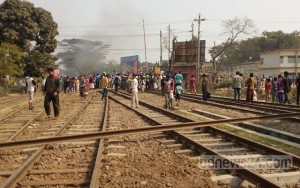
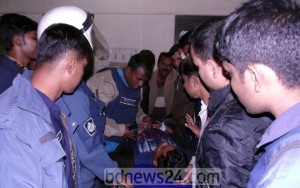
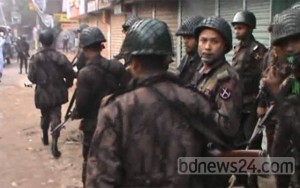
Madrasa students on the rampage in Brahmanbarhia

News Source


Nepal hopes for world support to implement new Constitution

Deputy Prime Minister Kamal Thapa on Tuesday expressed hope that the world community would support Nepal for the smooth implementation of the new Constitution and assured that all “genuine concerns” of the Madhesis would be addressed through dialogue.

Addressing chiefs of diplomatic missions based here and representatives of donor agencies, Thapa, who is also foreign minister, noted that Nepal has become only the second country in South Asia to draft its constitution through a democratically-elected constituent assembly.

Thapa also thanked the international community for its support in concluding the peace process and promulgation of the new Constitution in September last year.

“I am also confident of receiving your continued support which is crucial for the implementation of this Constitution,” he said.

“Nothing is perfect in this world,” he said adding “Nepal’s new constitution encompasses the main features of a democratic and inclusive polity to judge by any fair standard”.

“Commitment has been expressed in the very Preamble to democratic norms and values, civil liberty, fundamental freedoms, human rights, adult franchise, periodic elections, complete press freedom and an independent, impartial and competent judiciary, and the rule of law,” he said.

He said that the new constitution has guaranteed the rights of socially backward groups and communities based on principle of inclusion.

Stating that a few political parties, especially Madhes-based parties, have expressed discontent over some of the provisions of the new statute, Thapa stressed that Nepal government has repeatedly made it clear that the Constitution is dynamic in a true sense and genuine concerns can and will be addressed through dialogue.

Nepal has been in political turmoil as the Indian-origin Madhesi people are opposing the seven-province model of federalism which was introduced in the country through the promulgation of the new Constitution.

Madhesis are also protesting against division of their ancestral homeland under the new structure and have led an ongoing blockade of key border trade points with India.

Thapa said as a result of several rounds of dialogue between the government and the agitating leaders an amendment bill has been tabled to address the demands of proportional inclusiveness in state organs and delineation of electoral constituency on the basis of population while maintaining at least one seat in each geographical district.

He noted that a high-level mechanism with representatives of major parties will be formed to settle the dispute over demarcation of provinces.

Lauding the Indian government’s statement on the amendment proposal as an encouraging and positive gesture, Thapa hoped that problems would be resolved soon.

He said supply of commodities from the southern border check points that were disrupted following the promulgation of new constitution has been gradually improving in recent days.

“I have been informed that all other check-points, except Raxaul-Birgunj, are now operational,” said Thapa.

The continued disruption of supplies, especially medicines and food might lead to a humanitarian crisis, Thapa said adding that the government has conveyed this concern to the Indian authorities.

He hoped the supply situation will return to normal with resumption of all border check-points within a few days.

Highlighting the foreign policy of the new government, Thapa said that the country is fully committed to further strengthening relations with its neighbours and all other friendly nations.

“We pursue the policy of friendship with all and enmity with none. It was in pursuance with this commitment that I visited India and the People’s Republic of China where I had very fruitful discussions on matters of mutual interest with my counterparts and other high dignitaries,” he said.

“The government is serious about the reconstruction of the infrastructures, both public and private, damaged by the earthquakes,” he said.

“I am pleased to say that with passage of Reconstruction Authority Act by the Legislature-Parliament and the appointment of its CEO, the Authority has started its task,” he said.

Thapa further requested all donor countries to use government channels for their support and firmly recognise the national leadership and ownership in development efforts rather than channelling such precious resources through non-transparent agencies, NGOs and other entities.


BJP highlights Malda riots' 'truth' with five questions for Mamata

Hours after its three-member delegation was detained and sent back without their planned visit to violence-torn Malda district, Bharatiya Janata Party (BJP) on Monday levelled serious allegations against West Bengal Chief Minister Mamata Banerjee.

Accusing Mamata Banerjee of failing to control violence at Kaliachak despite reports about brewing tension in advance, BJP senior leader Siddharth Nath Singh on Monday indicated that Kaliachak police station was attacked to destroy records about opium farming and fake currency racket in the area.

He also said the three party MPs – SS Ahluwalia,  BD Ram and Bhupender Yadav, who were part of the BJP’s delegation to Malda, will meet the President and Union Home Minister Rajnath Singh after returning to Delhi.

Singh said the BJP is posing five questions before Mamata Banerjee:

1. The incident (Malda violence) happened on January 3. Leaflets, pamphlets and other publicity materials were being openly distributed in the area in advance to provoke the communal flare. Then why did state government failed to take precautionary measures and curb the violence on time?

2. Mamata govt is calling Malda violence a reaction to a provocative statement against Prophet Muhammad made one month ago. So why was this reaction after a gap of one month? It was not a reaction but a planned action.

3. Mamata Banerjee is saying the violence was between locals and BSF. If it was so, then why the mob attacked police station? They should have attacked or gathered at BSF posts.

4. NIA has been working on the investigation into Malda fake currency racket. More than 50 persons have been arrested in the past and most of them were from Malda. NIA was in touch with West Bengal govt to burst this racket. There were crucial records at Kaliachak police station which was attacked by the mob.

5. There is widespread opium farming taking place in Malda. Aren’t the state government and police aware of it? Why is West Bengal govt sleeping over it?
Opium farming here leads to fake currency rackets and other anti-national activities. This is why the police station which had crucial information regarding these cases was attacked.


Earthquake hits India's Manipur state

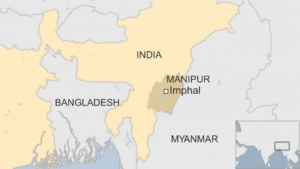
An earthquake measuring 6.8 magnitude has hit northeast India, near its border with Myanmar and Bangladesh, the US Geological Survey (USGS) has said.

The quake hit at 04:35 local time (23:05 GMT Sunday) about 29km (18 miles) northwest of Imphal, the capital of Manipur state, according to USGS.

Strong tremors have been felt across the region. _87466115_indiamanipurimphal4640116

Our reporter in Dhaka says many people were seen fleeing their homes in Bangladesh.

USGS issued a yellow alert for casualties and damage, with a 35% likelihood of between one and 10 deaths from the tremor.

The earthquake was originally reported to have measured 6.8 magnitude.

The region has a history of powerful earthquakes caused by the northward collision of the Indian and Eurasian plates. They are moving towards each other at a rate of 4-5cm per year.

In 2005, a magnitude 7.6 quake in Pakistan-administered Kashmir left more than 75,000 people dead.

In April 2015, Nepal suffered its worst earthquake on record with 9,000 people killed and about 900,000 homes damaged or destroyed.


Saudi Arabia breaks off ties with Iran

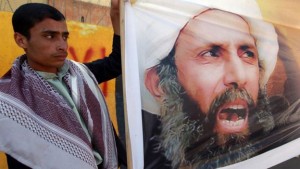
Saudi Arabia says it has broken off diplomatic ties with Iran, amid a row over the Saudi execution of a prominent Shia Muslim cleric.

Saudi Foreign Minister Adel al-Jubeir was speaking after demonstrators had stormed the Saudi embassy in Tehran.

Sheikh Nimr al-Nimr and 46 others were executed on Saturday after being convicted of terror-related offences.

Mr Jubeir said that all Iranian diplomats must leave Saudi Arabia within 48 hours.

Saudi Arabia was recalling its diplomats from Tehran, he said.

Mr Jubeir said Saudi Arabia would not let Iran undermine its security, accusing it of having “distributed weapons and planted terrorist cells in the region”.

“Iran’s history is full of negative interference and hostility in Arab issues, and it is always accompanied by destruction,” he told a news conference.

US state department spokesman John Kirby said: “We will continue to urge leaders across the region to take affirmative steps to calm tensions”.

“We believe that diplomatic engagement and direct conversations remain essential,” he said.

Saudi Arabia says it has broken off diplomatic ties with Iran, amid a row over the Saudi execution of a prominent Shia Muslim cleric.

Earlier, Iran’s Supreme Leader Ayatollah Ali Khamenei warned that the Sunni Muslim kingdom would face “divine revenge” for the execution – an act which also angered Shia Muslims elsewhere in the Middle East.

Ayatollah Khamenei called Sheikh Nimr a “martyr” who had acted peacefully.

Protesters stormed the Saudi embassy in Tehran late on Saturday, setting fire to the building before being driven back by police. The Saudi foreign ministry said none of its diplomats had been harmed in the incident.


Iran is Saudi Arabia’s main regional rival – they back opposing sides in the conflicts in Syria and Yemen.

Relations between the countries have been strained over various issues in recent decades, including Iran’s nuclear programme and deaths of Iranians at the Hajj pilgrimage in 1987 and again in 2015.


Who was Sheikh Nimr al-Nimr?

 News of Sheikh Nimr's execution prompted an angry response from Shias across the region

News of Sheikh Nimr’s execution prompted an angry response from Shias across the region

  • In his 50s when he was executed, he has been a persistent critic of Saudi Arabia’s Sunni royal family
  • Arrested several times over the past decade, alleging he was beaten by Saudi secret police during one detention
  • Met US officials in 2008, Wikileaks revealed, seeking to distance himself from anti-American and pro-Iranian statements
  • Said to have a particularly strong following among Saudi Shia youth

Sheikh Nimr al-Nimr: Figurehead Shia cleric


Most of the 47 people executed by Saudi Arabia were Sunnis convicted of involvement in al-Qaeda-linked terror attacks over the last decade.

Sheikh Nimr was involved in anti-government protests that erupted in Saudi Arabia in the wake of the Arab Spring, up to his arrest in 2012.

The execution sparked new demonstrations in Saudi Arabia’s Eastern Province, where Shia Muslims complain of marginalisation, as well as in Iraq, Bahrain and several other countries.

The top Shia cleric in Iraq, Ayatollah Ali al-Sistani denounced the execution as an “unjust aggression”.

The leader of Lebanon’s Shia Hezbollah movement, Hassan Nasrallah, launched his sharpest attack yet on the Saudi ruling family on Sunday, accusing them of seeking to ignite a Shia-Sunni civil war across the world.

He said the blood of Sheikh Nimr would “plague the Al Saud [family] until the Day of Resurrection”, prompting cries of “Death to the Al Saud!” among an audience watching his address.


News Source


Battle for Pathankot Indian airbase enters second night

The battle between Indian troops and militants who attacked an air force base at Pathankot near the Pakistani border has entered a second night.

At least four attackers and seven Indian soldiers have died so far.

It is unclear whether all the militants have been killed, with the home secretary saying two gunmen were still at large.

The attack is being seen as a blow to an apparent Indo-Pakistani peace initiative launched just days ago.

Hopes for a thaw in relations were raised after Indian Prime Minister Narendra Modi paid an unexpected visit to his Pakistani counterpart, Nawaz Sharif.

Fresh gunfire and a blast were heard at the base on Sunday, more than a day after the attack started.

Pakistan’s foreign ministry and the US State Department have condemned the attack.

 Helicopoters have been involved in the operation to secure the base

Helicopoters have been involved in the operation to secure the base

The attack started before dawn on Saturday, when a group of gunmen – wearing Indian army uniforms – entered the residential quarters on the base.

Hours of heavy gunfire followed, and a helicopter was seen firing at the facility. On Saturday afternoon, police said the base had been secured.

However, fresh gunfire was reported on Sunday morning.

A senior government official, Home Secretary Rajiv Mehrishi, troops were battling at least two gunmen who had been cornered at the site.

At least one explosion – suspected to have been caused by a grenade – was heard on Sunday. Local news reports said a soldier from a commando unit had been killed while defusing explosives.

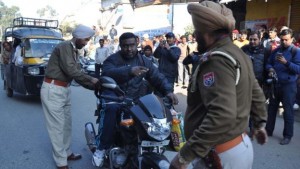
 India's Punjab state is on alert following the attack

India’s Punjab state is on alert following the attack

The identity of the attackers is not clear. Some Indian security officials suggested the Islamist militant group Jaish-e-Mohammed was to blame.

India says the group is backed by Pakistan, but Islamabad denies this.

In July seven people were killed in a similar attack when gunmen stormed a police station in nearby Gurdaspur district. The three attackers in Gurdaspur were killed after a 12-hour standoff with police.

Pathankot air force base is about 430km (270 miles) north of the Indian capital, Delhi and is on the road linking Indian-administered Kashmir with the rest of the country.

Indian-administered Kashmir has seen a long-running insurgency against rule from Delhi, and Kashmir has been a flashpoint in relations between Pakistan and India for nearly 70 years since independence.


Death for Bangladesh blogger killers

Two students have been sentenced to death in Bangladesh for the killing of an atheist blogger there in 2013.

Six others were convicted of involvement in the murder of Ahmed Rajib Haider, who was hacked to death as he was returning home from a rally in the capital, Dhaka.

A five-year sentence was given to the head of Ansarullah Bangla, the group suspected of carrying out the attack.

Five more secular bloggers and writers were killed in Bangladesh in 2015.

The court said that one of the students sentenced to death, Faisal bin Nayeem, attacked Haider with a meat cleaver in front of the victim’s house.

The other was tried and sentenced in absentia.

Haider was among a group of bloggers who had called for the execution of Islamist leaders for crimes committed in the 1971 war.

The blogger’s father, Mohammad Nazim Uddin, said he was unhappy that only two men were given the death sentence.

“I’m not happy with the verdict. I reject this verdict. Five of them confessed their involvement in the killing. But only two were given death sentence. How is it possible?”, he said.

There have been several clashes in recent years between Islamists and supporters of the secular Awami League.


‘JMB man admits’ role in Iskcon temple attack

Suspected militant of banned Islamist outfit Jama’atul Mujahideen Bangladesh (JMB) held over the attack on an Iskcon temple in Dinajpur is said to have confessed his role in the attack.

Detained Shariful Islam, 28, gave his confession before the Dinajpur chief judicial magistrate yesterday, our local correspondent reports quoting Redwanur Rahim, officer-in-charge of Detective Branch of police in Dinajpur district.

Shariful was caught red handed during the attack on Iskcon temple on December 10. He later confessed to have shot Italian pastor and doctor Piero Parolari in the district.


PM cautions against BDR mutiny like incident

Prime Minster Sheikh Hasina today asked BGB personnel to remain alert so that incident like the 2009 BDR mutiny does not recur in the future.

“BGB has turned into a dynamic and modern force with the sincere efforts of all. Through your hard labour, the reputation and dignity of this force have been restored…you must stay alert so that such suicidal incident cannot take place in the future,” she said.

The prime minister was addressing the formal parade of BGB Day-2015 held at the BGB (Border Guard Bangladesh) Headquarters in the city.

Terming the mutiny and killings at Peelkhana on February 25-26, 2009 as a black chapter of this force, Sheikh Hasina said she had to face the heinous and unstable situation like BDR mutiny and killings soon after assuming office and tackled it with the united efforts of the BGB members.

Mentioning that the BGB is now fully free form its stigma following the trial of its unruly and misleading personnel involved with the mutiny, she asked the BGB personnel to discharge their duties with utmost honesty and patriotism and thus gain the confidence and trust of people.


Delhi gang rape juvenile released

Youngest convict in 2012 Delhi gang rape is released from correction centre, his lawyer tells the BBC.

This news story is being updated and more details will be published shortly. Please refresh the page for the fullest version.

Legal challenges and protests from the victim’s parents had failed to prevent the release.

The rapist, who cannot be named as he was a minor at the time of the crime, was sentenced to three years in a reform facility in August 2013.

The rape and the subsequent death of the woman caused global outrage.